
Blade Repair

Blade Repair

Blade Repair BR (70 h 20 min)

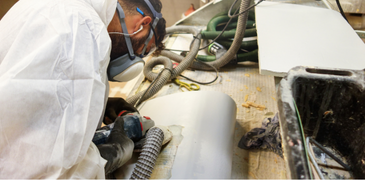
Aim: The aim of this module is to enable participants, through theoretical and practical training, to support and care for themselves and others working in the wind industry by possessing the necessary knowledge, skills, and ability for blade repair. Upon completion, participants will be able to perform and document a wind turbine blade inspection, and execute repair work in accordance with a work instruction while maintaining the aerodynamic profile and structural integrity.

PROGRAMME: Blade Repair
1. Introduction to the training
2. Blade Repair and legislative framework on chemical substances
2.1 Legislative concepts
2.2 Downstream users
3. Safety data sheets
3.1 Safety data sheets
3.2 Safety data sheet location
3.3 Safety instructions
3.4 Hazard labels and symbols
4. Work instruction
4.1 The work instruction (WI)
4.2 Locate work instruction
5. Risk assessments
5.1 Risk assessments
6. Secure an area
6.1 Locate procedures
6.2 Securing the area
7. Contamination
7.1 Characteristics
7.2 Work instructions as mitigation
7.3 Avoiding contamination
8. Waste segregation
8.1 Correct waste segregation
8.2 Waste segregation information
9. Ergonomics
9.1 Classroom
9.2 Workshop
9.3 Blade work
10. Lock Out Tag Out (LOTO)
10.1 Lock Out Tag Out
11. Personal protective equipment
11.1 Types & Purpose
11.2 Application
11.3 Limitations
11.4 Task specific
11.5 Disposal
12. Masks and filters
12.1 Purpose
12.2 Filter categories
12.3 Categories and lifetime
12.4 Masks
12.5 Apply filters
BR
Module BR Blade Repair
Duration:70 h 20 min (9 days)
Programme BR:Sections 1 to 34
Max. students:12 people per Edition
Prerequisites:None
Certificate Validity: No expiry (enduring qualification)
Vallecas (Madrid) — Spain
Total HSE
Telf.: +34 664 681 385 — [email protected]
PREMIUM
Andosilla (Navarra) — Spain
Total HSE
Telf.: +34 664 681 385 — [email protected]
SELECT
Las Palmas (Islas Canarias) — Spain
SEPROM
Telf.: +34 664 681 385 — [email protected]
SELECT
Redondela (Galicia) — Spain
Verticalia Formación
Telf.: +34 664 681 385 — [email protected]
SELECT
San José — Costa Rica
Desarrollos Floruma
Telf.: +506 2282-7468 — [email protected]
SELECT
Santiago de Chile — Chile
TTR Chile
Telf.: +569 42281266 — [email protected]
SELECT
13. Chemical safety
13.1 Purpose
13.2 Information about chemicals
13.3 Equipment check
13.4 Prevention and mitigation
13.5 Transfer procedures
14. Composites and blade construction
14.1 Aerodynamics
14.2 Blade construction
14.3 Sandwich panel
14.4 Blade enhancements
14.5 Faults, implications and mitigations
15. Materials
15.1 Reinforcement materials
15.2 Matrix materials
15.3 Adhesives
15.4 Surface coatings
15.5 Chemical handling and application
15.6 Curing
16. Tools and equipment
16.1 Mechanical, electrical and pneumatic principles
16.2 Utilisation of tools and materials
16.3 Calibration
16.4 Lamination tools
16.5 Heating blankets
Page 1 of 2
16.6 Checking electrical tools and equipment
16.7 Vibrating tools
16.8 Electrical safety devices
16.9 Documentation types
17. Phase test
17.1 Phase test
18. Lamination skills
18.1 Fibre orientation
18.2 Fibreglass mats
18.3 Kinked or bent fibres
18.4 Overlaps
18.5 Dry fibres and air voids
18.6 Mixing ratio
18.7 Calculation of matrix material
18.8 Curing at elevated temperatures
18.9 Ascertaining correct curing
18.10 Ambient temperature and humidity
18.11 Recording ambient temperature and humidity
19. Basic lamination
19.1 Minimise risks associated with fibre work
19.2 Fibre orientation and moulding theory
20. Sandwich panel
20.1 Minimise risks associated with composite fibre work
20.2 Sandwich construction
20.3 Curing of fibre reinforced composite laminate
20.4 Producing a composite sandwich panel
20.5 Trailing edge section
21. Painting
21.1 Completion of blade
22. Blade inspection
22.1 Typical failures
22.2 Reactions to damage categories
22.3 Focused and scaled photographs
22.4 Tap test
22.5 Lighting
22.6 Inspection tools and methods
22.7 Types of damage
23. Inspecting lightning protection system
23.1 Surface components
23.2 Visual conductivity inspection
23.3 Measure resistance
24. Sanding skills
24.1 Sanding
25. Grinding skills
25.1 Grinding
26. Surface repairs
26.1 Minimise risks associated with composite fibre work
26.2 Filler adhesion
26.3 Reproduce surface profile
26.4 Paint adhesion
26.5 Layer thickness
26.6 Apply paint with a roller
26.7 Layer thickness with wet film
26.8 Record ambient temperature and humidity
26.9 Inspection and documentation
27. Laminate repairs
27.1 Minimise risks associated with composite fibre work
27.2 Safe removal of damaged material
27.3 Identifying fibre direction
27.4 Reinforcement overlaps and matrix adhesion
27.5 Mixing
27.6 Repair layers
27.7 Wetting out fibres using appropriate tools
27.8 Wetting out fibres with matrix material
27.9 Vacuum consolidation
27.10 Curing the repair using heating blankets
27.11 Verifying the curing
27.12 Recording the ambient temperature and humidity
28. Filling and shaping
28.1 Filler
29. Trailing edge repairs
29.1 Minimise the risks associated with composite fibre work
29.2 Repair task
29.3 Crack repairs
29.4 Recreating blade profile
29.5 Record ambient temperature and humidity
30. Leading edge repairs
30.1 Minimise risks associated with composite fibre work
30.2 Repair task
30.3 Leading edge repair
30.4 Relocate leading edge
31. Sandwich panel repair
31.1 Minimise risks associated with composite fibre work
31.2 Repair task
31.3 Repair inner and outer laminate
31.4 Replacement core
31.5 Inspection and documentation
32. Bond line repairs
32.1 Debonding
32.2 Injection of adhesive
32.3 Injecting material in the trailing edge
33. Summary and final test
33.1 Summary
33.2 Final test
34. Training review
34.1 Training review
34.2 Feedback session
Page 2 of 2