
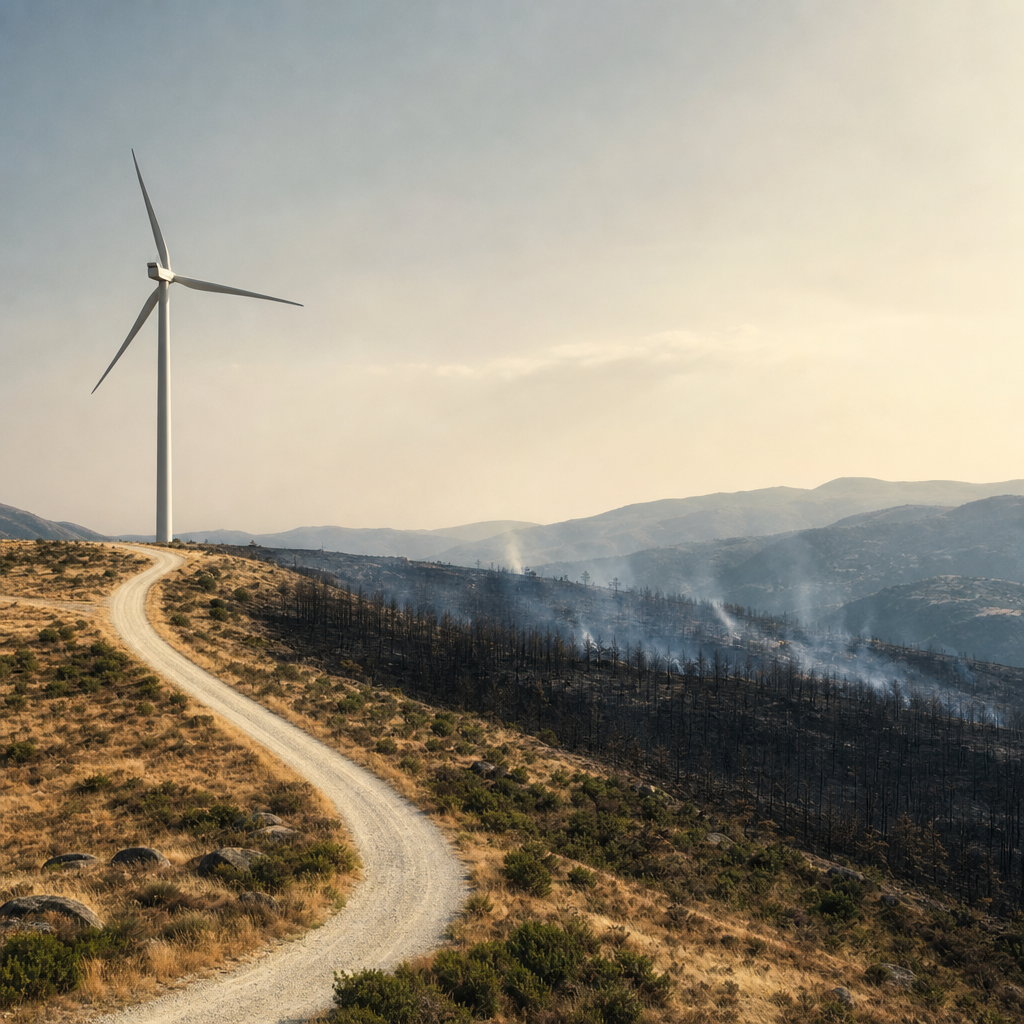
Wind Farms Key to Wildfire Prevention in Heat-Stricken Europe
Heat waves are becoming more frequent and temperatures are rising year after year. At the dawn of summer, deaths linked to extreme heat are already counted in the thousands across Europe, with more than a hundred in Galicia alone. Climate change is an observed, measured, and quantified reality that is intensifying its impact and health risks. Prolonged droughts and extreme heat place invisible stress on the land, directly influencing the spread and severity of wildfires.
The tragedy in Almería, with lives lost, is painful to recall. Massive fires such as the one in Guadalajara, which burned vast forest areas and proved extremely complex and dangerous to extinguish, remain fresh in public memory. In Galicia, the devastating wildfires in Ourense last August are still vivid.
Wind Farms as Strategic Allies in Fire Prevention
It is important to remember that wind farms can be strong allies in wildfire prevention. Access roads often function as firebreaks, helping to slow or contain the spread of flames. Monitoring systems installed in wind turbines enable early detection of anomalies and faster response times. In addition, maintenance personnel working regularly on site can support early warning efforts.
A clear example occurred in Viveiro in 2023, where an evacuation line linked to a wind project acted as a firebreak, preventing a much larger forest area from burning. It also facilitated access for firefighting vehicles. These structural features and safety systems within wind facilities provide an added layer of defense against forest fires, which have increased by 80 percent in recent years according to data from the Spanish Government.
Clean Electricity and Europe’s Energy Strategy
The primary objective of a wind farm is the generation of clean electricity. Europe has consistently supported the acceleration of renewable energy deployment, considering it to be of overriding public interest, although this principle is not always fully applied in practice.
Amid the ongoing energy transition and current geopolitical tensions, the European Union advocates for the massive electrification of the economy. The goal is clear: electricity should be more competitive than fossil fuels, even to the extent of being taxed less than gas. According to the European Commissioner for Energy, Europe has paid €50 billion more without receiving additional energy, while continuing to subsidize fossil fuels has been compared to giving sugar to a diabetic.
Reducing toxic emissions remains a shared responsibility. In Galicia, this challenge is closely linked to transport and heating, especially since the closure of the Meirama and As Pontes coal-fired power plants, formerly the main sources of greenhouse gas emissions in the region.
Galicia’s Uncertain Energy Future
However, Galicia faces another pressing issue: the judicial suspension of around 90 wind projects over the past five years. Their environmental processing has been deemed correct and supported by several rulings of the Spanish Supreme Court and the Court of Justice of the European Union.
Today, Galicia’s energy future appears uncertain and paradoxical. The region has abundant wind resources and a highly skilled industrial network. There are business initiatives and multi-billion-euro investments awaiting the development of 8 TWh of new renewable energy. Yet the wind sector, a key driver of economic progress in Galicia and a source of green, local, and affordable electricity, remains stalled. It is, in many ways, an invisible and destructive fire.
By Manuel Pazo, President of the Galician Wind Energy Association.
Did you know we offer training related to this topic? Explore our GWO Basic Safety Training to develop essential safety skills for working in the wind energy sector, and strengthen your technical expertise with the GWO Basic Technical Training, focused on electrical, mechanical, and hydraulic systems in wind turbines.