
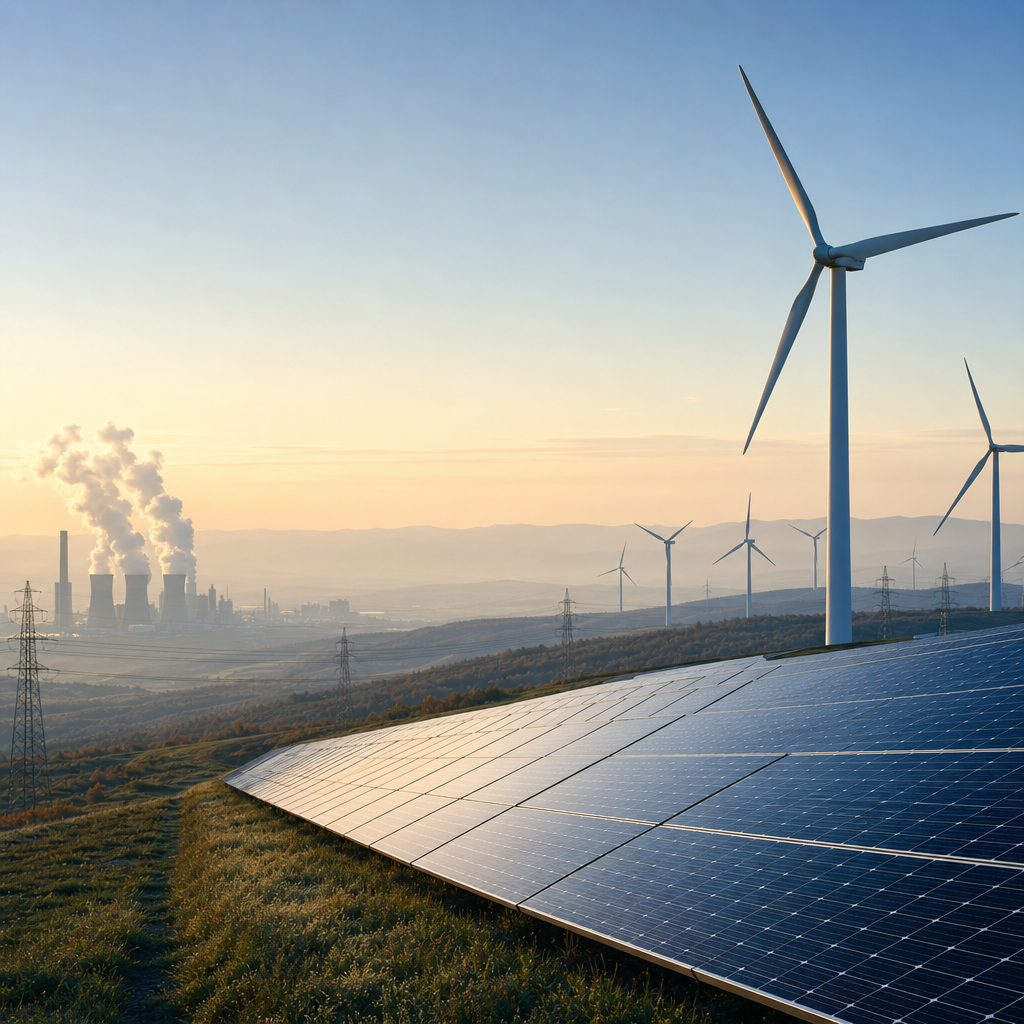
Wind and Solar Lead Growth as Global Energy Hits Record
Global energy consumption continues to climb despite the acceleration of renewables. According to the latest data from the Energy Institute, clean energy sources are now leading growth worldwide, with wind and solar at the forefront, while electricity demand is expanding and gaining strategic weight. However, total energy consumption remains at historic highs, highlighting the scale of the challenge in replacing fossil fuels.
In 2025, global energy supply surpassed 600 exajoules (EJ), rising by 1.7%, setting a new all time record. Every energy source reached historic levels, but wind and solar stood out with an annual growth rate of 18.3%, becoming the largest contributors to new energy generation worldwide. Together, they now generate more electricity than hydropower and nuclear and covered the entire increase in global electricity demand last year.
Wind and solar outpace fossil fuels
Over the past decade, wind and solar have expanded much faster than traditional fuels, growing by more than 18% compared with 6% for coal, 9% for oil and 21% for gas. Unlike fossil fuels, almost all renewable output is delivered as usable electricity, whereas a significant share of fossil energy is lost as residual heat during combustion. This efficiency advantage reinforces the strategic role of electrification in the energy transition.
Despite this progress, fossil fuels still accounted for 86.2% of global energy supply, their lowest share on record but still overwhelmingly dominant. Global electricity demand increased by 3%, equivalent to 940 TWh, with data centers already representing 2% of total global power consumption. The figures illustrate a paradox: renewables are growing rapidly, yet overall demand continues to push every source to record levels.
It is important to note that most energy statistics are based on primary energy, which measures fossil fuels before transformation. Nearly two thirds of this energy is dissipated as heat during use, a factor that tends to overstate the weight of fossil fuels compared to renewables, whose conversion into electricity is significantly more efficient.
China consolidates its leadership
The report also underscores China’s growing dominance in the power sector. In 2025, China generated more electricity than the United States, the European Union and India combined. Its power system is expanding faster than other sectors of its economy, gradually reducing its historic reliance on coal and strengthening electrification as a central pillar of development.
Electricity now represents 30% of China’s final energy consumption, compared with 22% globally. International targets aim to raise that global share to 35% by 2035, reinforcing electricity as the backbone of decarbonization strategies.
Global impact and climate goals
The continued expansion of wind and solar directly supports SDG 7, Affordable and Clean Energy, by increasing access to low carbon electricity, and SDG 13, Climate Action, by accelerating emissions reductions. To put the scale into perspective, the annual growth in renewables now exceeds the total electricity consumption of many mid sized economies. Yet the persistence of fossil fuels at record volumes shows that the transition is not only about growth, but about replacement at an unprecedented pace.
The global energy system is entering a decisive decade. Wind turbines, solar parks and electrification are advancing faster than ever, but the real test lies in whether clean technologies can scale quickly enough to displace fossil fuels, not just coexist with them.
Did you know we offer training related to this topic? If you are working in wind energy or planning to enter the sector, our Basic Safety Training course is designed to prepare professionals for safe operations in wind turbines: https://totalhse.com/basic-safety-training/. For those looking to strengthen their technical skills in electrical, mechanical or hydraulic systems, you can also explore our Basic Technical Training: https://totalhse.com/basic-technical-training/.