
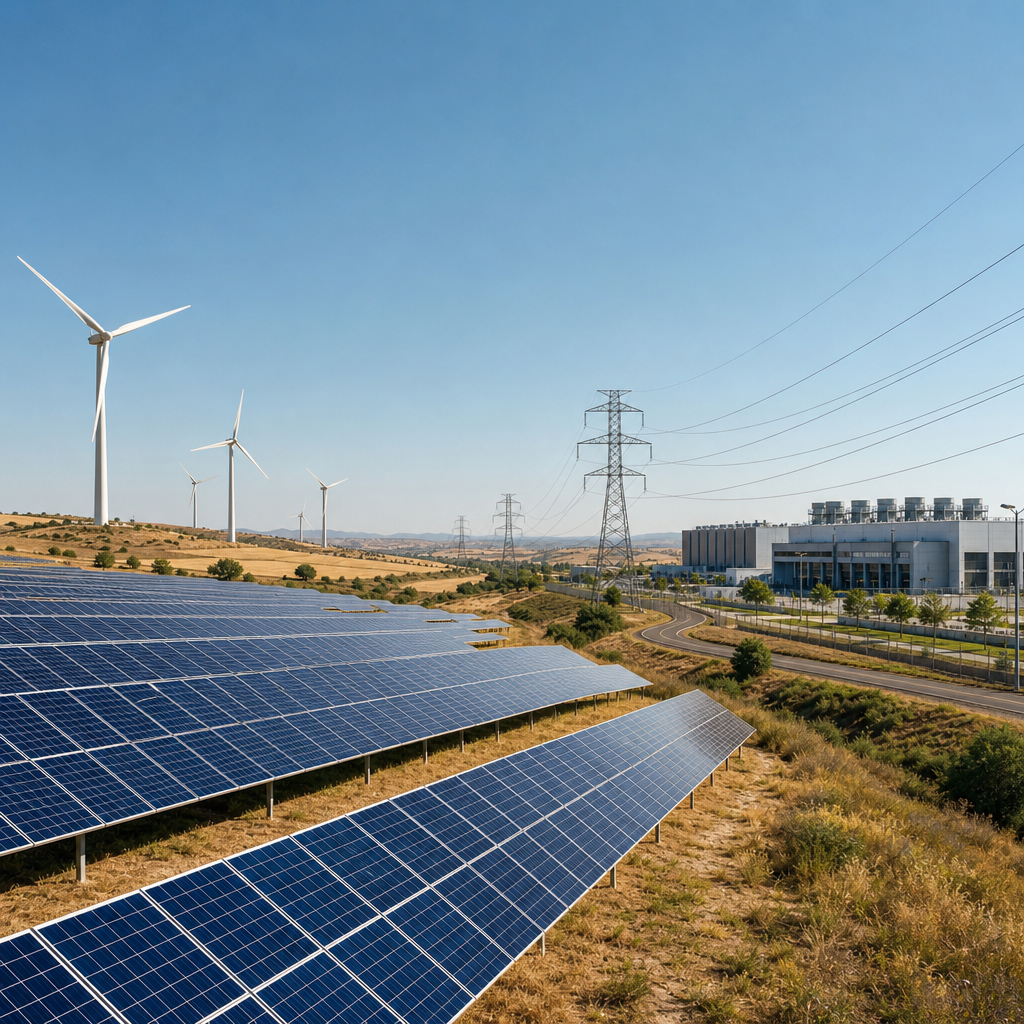
Spain’s Renewable Boom Faces Demand Electrification Challenge
The rapid growth of renewable generation has positioned Spain among the most competitive wholesale electricity markets in Europe. However, for this advantage to translate into greater investment, stronger industrial competitiveness and increased stability for renewable projects, it will be necessary to accelerate demand electrification, reinforce grids and transfer wholesale price signals more efficiently to end consumers, according to an analysis by AleaSoft Energy Forecasting.
The mismatch between renewable generation and demand
In recent years, Spain has experienced a significant expansion of its renewable fleet, particularly in wind and photovoltaic technologies. This growth has reduced dependence on fossil technologies in price formation and has helped position the Spanish electricity market among the most competitive in Europe in wholesale terms. Nevertheless, electricity demand has not advanced at the same pace as installed capacity.
This mismatch between generation and demand is creating increasing tensions during certain hours of the day. High solar production during central hours, combined with insufficient demand to absorb all that energy, has increased the frequency of low, zero or even negative prices. This situation directly affects the revenues of renewable projects and may reduce the attractiveness of new investments if system imbalances are not addressed.
The impact varies depending on the technology, its production profile, its location and its exposure to market prices. However, the underlying challenge is common across the renewable sector: ensuring sufficient demand, flexibility, storage and grid capacity to integrate new generation.
Demand as a balancing factor in the electricity system
Recent developments in the Iberian market show that moderate increases in demand can have a significant impact on prices. Rising temperatures and the associated electricity consumption for cooling have contributed in recent weeks to reducing the number of hours with zero or negative prices. This behavior highlights the importance of demand as a balancing factor in a system with high renewable penetration.
Electrification of new end uses of energy
The electrification of industry, transport, data centers, thermal consumption and other end uses of energy will therefore be decisive in unlocking Spain’s full renewable potential. The greater the level of flexible and electrified demand, the higher the system’s capacity to integrate renewable generation, reduce curtailment and sustain price levels that allow asset profitability.
The growth of flexible demand will help optimize production from different renewable technologies, reduce curtailments and constraints, improve captured prices and limit projects’ exposure to prolonged periods of low prices.
However, competitive wholesale prices alone are not enough to drive electrification. These advantages must reach end consumers. The structure of network tariffs, regulated charges and tax components can dilute wholesale price signals and weaken incentives to replace fossil fuel consumption with electricity.
Another key challenge is grid access. Some demand seeking electrification faces difficulties in obtaining connection points or sufficient capacity. Advancing grid development, ensuring connection availability and implementing regulation that facilitates the integration of new industrial and flexible demand will be essential.
The next phase of the energy transition
In this context, the next major challenge of Spain’s energy transition will not only be to continue installing more renewable generation, but to ensure that demand grows in parallel. After an initial phase focused on the success of renewable supply, the next stage must shift attention toward demand growth, flexibility and the final competitiveness of electricity.
The importance of long term forecasts
Long term forecasts for prices, demand and renewable production will be essential in assessing these scenarios. For consumers, retailers, developers, banks and investment funds, having a robust view of demand evolution and its impact on prices will be crucial for making informed investment, contracting and hedging decisions in the coming years.
For renewable generators, it will be especially important to analyze the evolution of technology-specific captured prices, production constraints, the integration of storage and the effect of new electric loads on future project revenues.
AleaGreen analysis to assess electrification and flexibility scenarios
As demand electrification gains momentum, the need to evaluate how new electric consumption, storage, hybridization, PPA contracts and demand management strategies can modify market exposure and project profitability will increase. AleaGreen applies tailored studies to specific cases, incorporating assumptions about renewable penetration, captured prices, consumption profiles, flexibility and overall system evolution. In this way, clients can compare alternatives, quantify risks and define coherent strategies in a market where demand will play an increasingly active role.
Did you know we offer training related to this topic? Explore our GWO Basic Safety Training and develop essential safety skills for working in the wind energy sector, supporting the safe deployment and operation of renewable energy projects.