Skylift Enables Wind Turbine Installation in 15 m/s Winds
Global wind deployment continues to expand into increasingly demanding environments, where stronger and more consistent wind resources promise higher energy yields but also pose major construction challenges. In this context, Skylift, developed by Nabrawind, enables the installation of complete wind turbines in sustained winds of up to 15 m/s and gusts of 20 m/s, effectively doubling the operational wind threshold of conventional crane-based methods.
Authored by Ion Arocena, CTO of Nabrawind, this technical overview details how the system overcomes one of the sector’s long-standing bottlenecks: the inability of traditional cranes to safely lift large components, particularly blades, in high-wind conditions. As a result, many high-resource sites have historically remained undeveloped not due to lack of wind, but due to installation constraints.
A crane-free installation concept for extreme wind sites
Skylift integrates two proprietary technologies: the Total Self-Erecting System (T-SES) and BladeRunner, a hub-integrated blade installation system. Together, they enable a fully crane-free erection sequence.
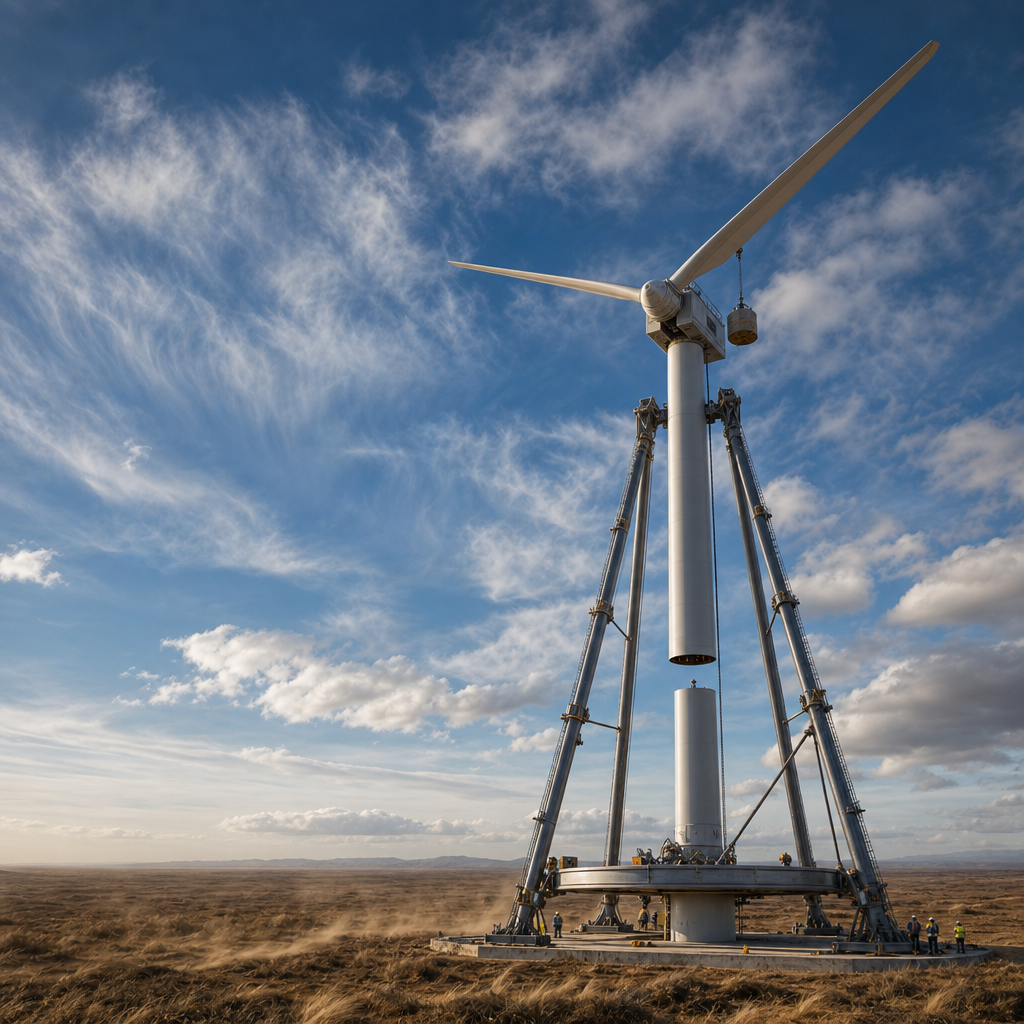
The process begins with the installation of an auxiliary central base on the foundation, allowing precise alignment of tubular tower segments. The upper tower section, nacelle and hub are then assembled at ground level. In the case of direct drive turbines such as the Goldwind GW165/6000 used at the InnoVent Diaz wind farm in Namibia, two blades are pre-installed at approximately 30 degrees, while a counterweight balances the rotor during lifting.
The T-SES is then assembled and proceeds to lift the entire turbine structure. Unlike conventional top-down stacking with cranes, this method builds the tower from the bottom up, sliding in new segments sequentially beneath the suspended structure. Once the tower reaches full height, BladeRunner completes the rotor installation. For direct drive machines, it first removes the counterweight before installing the third blade.
This approach was validated at full scale in Namibia, one of the world’s highest wind resource locations, providing real-world confirmation of the system’s robustness under extreme conditions.
Four patented systems enabling high-wind installation
Total Self-Erecting System (T-SES)
The T-SES forms the structural core of Skylift. Transported in 16 standard trucks, it consists of three masts connected at the top, between which a lifting triangle moves vertically using winches, pulleys and cables anchored at ground level.
Adapting the original Self-Erecting System to tubular steel towers required a significant engineering breakthrough. Unlike lattice structures, tubular towers offer no dedicated anchoring points. Nabrawind’s solution transfers vertical loads and wind-induced overturning moments through radial beams and strut columns that clamp around the smooth conical surface, creating a defined load path from the tower to the lifting triangle and down to the ground.
Once connected, the turbine and T-SES behave as a rigid, guided structure. This dramatically reduces wind-induced oscillations compared to crane-suspended components, allowing safe operation in sustained winds of 15 m/s, conditions that would halt conventional lifting operations.
Auxiliary Counterweight System for Direct Drive Rotors
Direct drive turbines present an additional constraint: the rotor cannot be mechanically locked in the same way as geared machines during installation. Skylift addresses this by pre-installing two blades and balancing the rotor with a dedicated counterweight.
The turbine is then self-erected with a partially bladed, unlocked rotor. After full tower erection, BladeRunner removes the counterweight and installs the third blade, completing the rotor assembly. This adaptation ensures compatibility with modern high-capacity direct drive platforms.
Auxiliary Central Base (ACB)
Bottom-up tower assembly requires millimetric alignment between the suspended turbine and each new tower segment introduced from below. The Auxiliary Central Base (ACB) fulfills this dual structural and positioning role.
Designed as a clover-shaped welded structure supported on legs, the ACB withstands the full vertical load and overturning moment of the turbine. At the same time, a low-friction rotating table powered by four double-acting hydraulic cylinders enables controlled displacement along the X and Y axes and rotation around the Z axis. This allows repositioning of a 165-meter turbine structure with high precision while fully loaded, a demanding combination of strength and maneuverability.
BladeRunner
BladeRunner is a hub-integrated lifting system originally developed for major corrective operations but fully adaptable to new installations. By eliminating the need for a main crane during blade mounting, it significantly reduces logistical complexity and weather-related downtime.
In standard configurations, BladeRunner installs all three blades after tower erection. In direct drive applications, it first removes the counterweight before mounting the final blade, ensuring a safe and controlled completion of the rotor.
Industrial validation and sector implications
The first full-scale deployment at the InnoVent Diaz wind farm confirms that wind turbines can be installed at a rate of one per week in extreme wind locations, without the need for a main crane. The entire system’s transport in just 16 trucks further reduces logistical exposure and associated costs.
By unlocking sites previously considered unfeasible, Skylift directly supports SDG 7, Affordable and Clean Energy, by expanding access to high-yield wind resources. At the same time, enabling development in optimal wind zones maximizes energy output per installed turbine, reinforcing SDG 13, Climate Action, through greater renewable generation efficiency.
For an industry increasingly moving toward larger turbines, complex terrains and high-capacity onshore and offshore wind turbines, crane-free and weather-resilient installation methods may prove decisive. Skylift demonstrates that the installation phase, long considered a limiting factor, can evolve at the same pace as turbine technology itself.
As wind projects continue to scale and push into harsher environments, the question is no longer whether high-wind sites can be developed, but how quickly the industry can adopt the technologies that make them viable.
Did you know we offer training related to this topic? If you are involved in wind turbine installation or maintenance, our Basic Safety Training for wind professionals is essential to operate safely in demanding environments. We also provide Basic Technical Training for electrical, mechanical and hydraulic systems, as well as Advanced Rescue Training for emergency response at height, all aligned with the needs of modern wind turbine projects.