
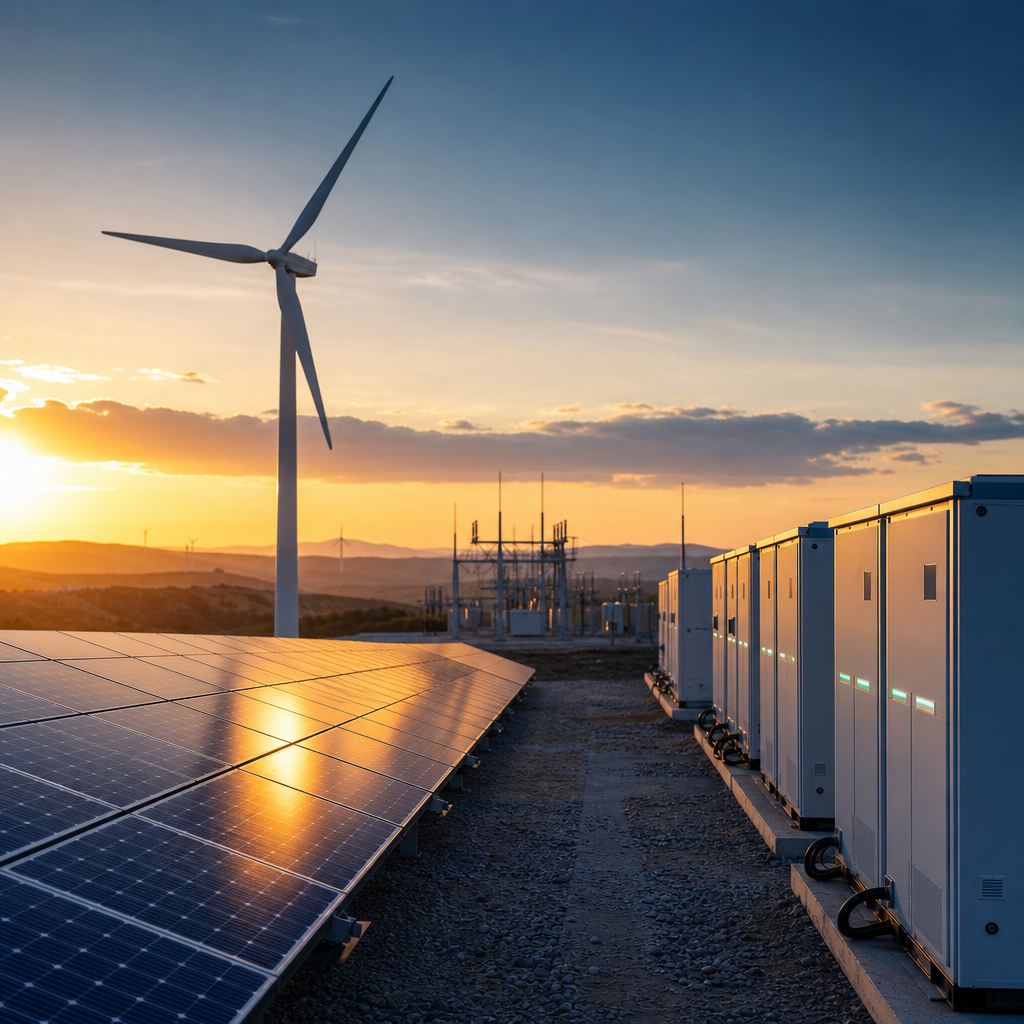
Hybrid Storage Becomes Key to Renewable Profitability
The renewable energy sector is entering a new phase shaped by market saturation and declining value during specific hours of the day. After years of rapid expansion, particularly in solar PV, European electricity markets, especially Spain’s, are showing clear signs of stress. Zero or negative prices, solar cannibalization, and the concentration of generation in limited time windows are eroding asset profitability. In this context, hybridization with energy storage is emerging as the structural solution to protect revenues and adapt assets to an increasingly volatile and competitive environment.
The structural loss of value
The traditional logic of renewable projects, based on maximizing production and securing revenues through PPAs or merchant exposure, is under growing pressure. The increasing frequency of zero or negative prices during peak solar hours, combined with photovoltaic cannibalization, where more generation directly depresses prices, is reducing the marginal value of energy.
The central question is no longer how much energy is produced, but when and at what price it is sold.
This shift is particularly challenging for merchant and semi merchant assets, where revenue exposure to market volatility directly impacts expected returns. Saturation during peak generation hours is creating a structural deterioration of income forecasts and forcing developers and investors to rethink operational strategies.
Hybridization as a new value architecture
In response, hybridization with energy storage represents far more than an incremental upgrade. It signals a fundamental change in operational logic. By enabling energy to be shifted toward higher value hours, participating in balancing markets, and smoothing revenue profiles, storage transforms the role of a renewable plant.
The facility ceases to be merely a generation unit and becomes an optimized energy management system.
In solar plus storage configurations, battery systems allow operators to capture intraday price spreads, minimize curtailment, and optimize sales during peak pricing windows. In many scenarios, this can translate into revenue increases of 20% to 40% compared to non hybridized operations.
For wind energy, storage provides additional flexibility. It mitigates resource variability, enables more active production management, and enhances revenue predictability. In advanced hybrid systems combining solar, wind and storage, technological complementarity reduces aggregated volatility and optimizes overall portfolio performance, creating value beyond individual assets.
This evolution aligns with broader sector trends, including digitalization, advanced forecasting, and predictive optimization tools, which are increasingly critical in both onshore and offshore wind environments.
A financial turning point
One of the most significant implications of hybridization is financial. Storage integration is reshaping bankability criteria by stabilizing cash flows, improving risk profiles, and enabling more sophisticated contractual structures.
A clear trend is emerging: financial institutions are beginning to require storage scenarios as part of project financing assessments. What was recently considered optional is progressively becoming a prerequisite.
However, not every hybrid project automatically creates value. A common risk lies in overestimating revenues when simplified models rely solely on average prices or historical spreads. Real world operation demands probabilistic scenarios and integration across multiple markets, including spot, intraday, and balancing services. Without this analytical rigor, project valuation and financing decisions can be significantly distorted.
At the same time, storage deployment introduces its own challenges. Potential future compression of spreads due to high battery penetration, uncertainty in long term price evolution, and evolving regulatory frameworks require cautious, data driven decision making.
Global impact and alignment with climate goals
Hybridization strengthens the contribution of renewables to SDG 7: Affordable and Clean Energy by improving system flexibility and ensuring that clean electricity is delivered when it is most needed. It also supports SDG 13: Climate Action, enhancing grid stability and reducing reliance on fossil fuel based peaking plants. By transforming intermittent generation into dispatchable capacity, storage acts as a bridge between renewable expansion and system reliability.
In practical terms, shifting energy from saturated midday hours to evening demand peaks can be the difference between curtailed clean power and meaningful decarbonization impact.
The new competitive standard
Hybridization is no longer a technological trend but the emerging competitive standard of the renewable sector. In a landscape defined by saturation and volatility, profitability depends not only on producing energy, but on managing it strategically.
Assets that fail to integrate this logic risk progressive value erosion. Those that embrace it will not only protect returns but redefine their role within the energy transition.
Did you know we offer training related to this topic? If you are working in wind energy or hybrid renewable projects, our Basic Safety Training course is essential for safe operations in wind turbines and energy facilities. For professionals involved in electrical and mechanical systems integration, our Basic Technical Training program provides the core skills needed to operate and maintain increasingly complex renewable and storage installations.